


MESSAGE FROM THE PRESIDENT
Dear IUKF Members:
Welcome to the third quarter 2026 IUKF newsletter. As some of us come to the end of summer while others emerge from winter, wherever we may be in the world, we share something that transcends seasons and geography, the practice of Uechi-Ryu Karate. What is it that makes the study of Uechi-Ryu so special? What keeps us practicing year after year, and for many of us, decade after decade?
The answers to those questions are deeply personal. Each of us came to Uechi-Ryu for different reasons, and those reasons may have changed over time. Some began for self-defense, others for sport, physical fitness, confidence, or personal growth. Yet, regardless of what first brought us to the dojo, many of us have discovered that Uechi-Ryu has a remarkable ability to remain relevant throughout our lives.
Our practice changes as we change. What we seek from our training at 20 may be very different from what we value at 40, 60, 70, or beyond. Strength and speed may change, but our understanding can deepen. Technique can become more efficient. Our appreciation for movement, principles, balance, breathing, discipline, and the simple act of continuing to practice can take on greater meaning.
Uechi-Ryu is something we can carry with us throughout our lives. It challenges us when we are young and helps sustain us as we grow older. It gives us an opportunity not simply to age, but to age with strength, purpose, and grace.
Whatever your personal reason for continuing to practice, I hope you occasionally take a moment to appreciate what Uechi-Ryu has brought into your life. We are indeed fortunate to have this wonderful practice and fortunate to share it with one another.
Justin Testa
President, International Uechi-Ryu Karate Federation
Q3 DAN PROMOTIONS
Mike Vena – Nanadan
Michaela Guenter – Yondan
Martin Beiel – Yondan
Nathaniel Harsent – Nidan
Scott Taylor – Nidan
Fabien Passily – Shodan
Congratulations to all!
DOJO NEWS
Master Ranks Testing:
As a reminder, the website now has a schedule for master rank promotions.

Black Belt Registry:
Let’s continue to work together as dojo Senseis to review the Black Belt Registry on the website carefully. It’s a great opportunity to ensure that all Dan ranks and titles are correctly listed for you and your dojo members. If you notice any updates or corrections, please send them to the IUKF email. (mailto: webmaster@iukf.net)
When applying for Dan grade certificates for Nidan and above, it’s incumbent on the Sensei applying to verify that the Dan Grade registry contains correct information for the candidate, including current rank, the date of the last grading, the IUKF number, and that the time in grade is met prior to submission of the application.
For Shodan applications, the date of the previous grade should ideally meet the recommendation set out in the Black Belt Test Guide. Kyu grade students should progress through each grade to ensure they have sufficient time in Kyu grade to advance to the next level. All applications will be reviewed and approved based on registry information.
Note: Dan promotion and Title certificate applications will not be processed unless at least the latest promotion or title award is in the Dan registry.
EVENTS
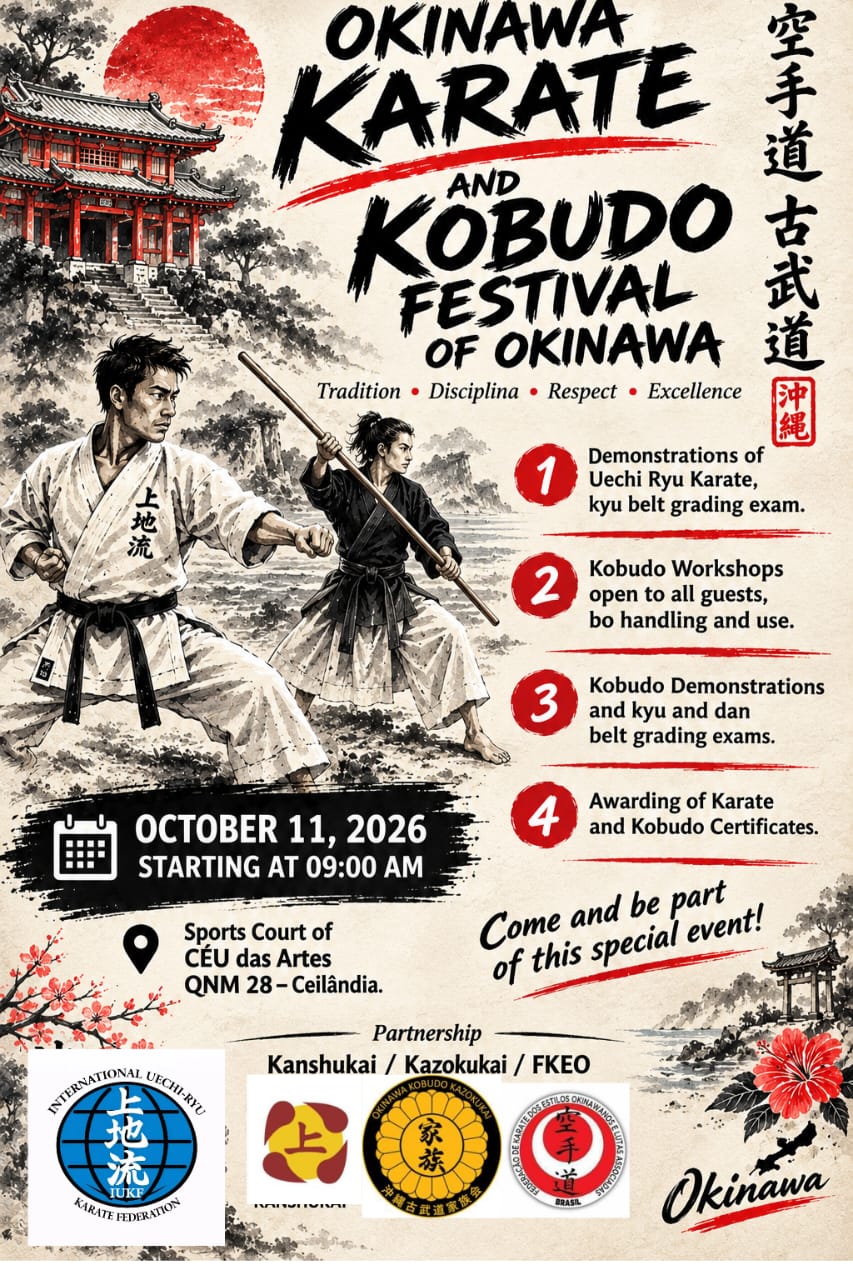
Uechi-Ryu Karate and Kobudo Festival
October 11, 2026
Ceilandia, Brazil
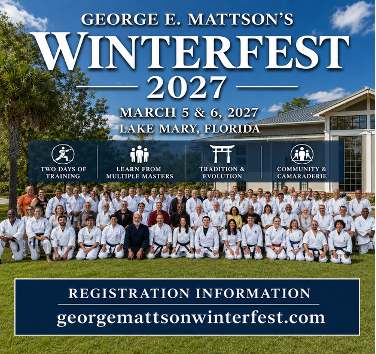
WinterFest 2027
Save the Date!
March 5 & 6th 2027
Lake Mary, Florida, USA
Online Workouts
Sitka Uechi-Ryu Club and the Mattson Academy of Karate regularly provide live online workouts and extend invitations to IUKF Dan-ranked members to participate. The schedules and links are available on the website. https://iukf.net/online-workouts/
IUKF Meeting
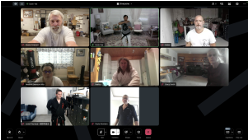
Watch for an announcement about an online Dojo Sensei meeting. We are targeting November.
COMMUNITY CORNER
IUKF EuroWorkout 2026
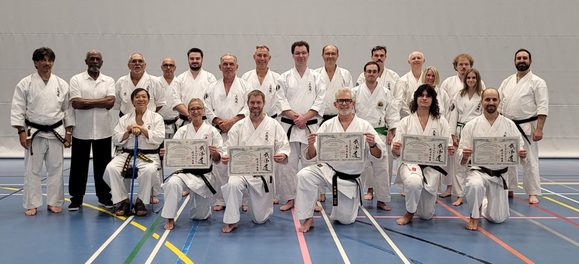
Canterbury, England, September 11–13, 2026 | Christ Church University Sports Center | Hosted by Hanshi Hachidan Lee Adams.
This year’s IUKF EuroWorkout brought together Uechi-ryu practitioners from three countries — Germany, UK, and the USA — for three days of testing, training, and camaraderie at Christ Church University in Canterbury.
Presenters:
- Grand Master Judan Darin Yee
- Grand Master Judan Alton Wharton
- Hanshi Kyudan Bruce Hirabayashi
- Hanshi Hachidan Lee Adams
- Kyoshi Nanadan Paul Kronschnabl
In addition to Dan Testing, the seminars included Uechi-ryu fundamentals, understanding bunkai, the Shogun Dojo bunkai, the 38-kick kata, and core Uechi-Ryu principles (single root, center of gravity, and connection to the ground).
Sanchin-On-Tour
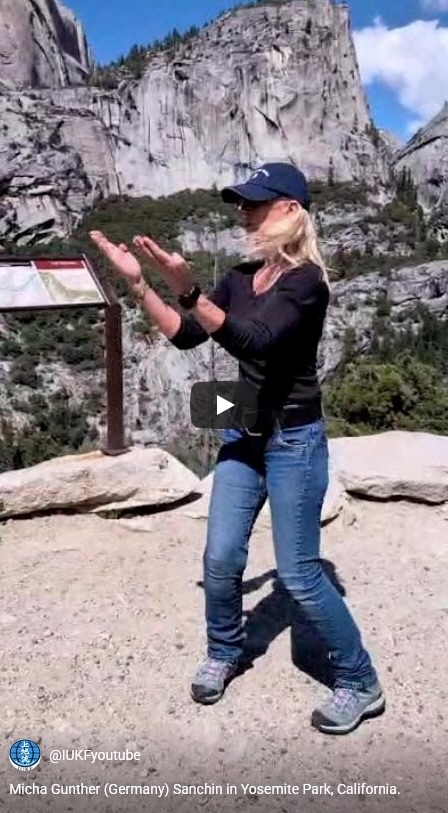
The IUKF invites you to share a video of your Sanchin kata while on vacation, hiking, on a business trip, or even in your backyard.



FEATURED ARTICLE
Understanding Bunkai: Looking Beneath the Surface of Kata
by Hanshi Lee Adams, 8-Dan
What is Bunkai?
The word Bunkai is often translated as “disassembly” or “analysis.” In simple terms, it is the process of breaking down a Kata—a prearranged solo form—to explore and understand the practical self-defense applications contained within its movements.
However, Bunkai, particularly at Master rank, is much more than simply taking a movement from a Kata and finding a way to make it work against an attacker.
A Kata is not necessarily a literal catalog of fighting techniques. Rather, it teaches principles, movement patterns, timing, positioning, and body mechanics. The application may therefore be considerably deeper than what we see on the surface. A movement that appears to be a block might also represent a deflection, strike, controlling technique, joint manipulation, or takedown. The same movement may have applications against different types of attacks. This is where the difference between simply knowing a Kata and understanding a Kata begins to emerge.
From Omote to Ura
One useful way of looking at Bunkai is through the concepts of Omote and Ura.
Omote can be thought of as the surface or visible interpretation—what we see when the Kata is performed. Ura takes us beneath that surface. It asks what else the movement might represent and, more importantly, whether its underlying principles can be applied in a realistic situation. At Master rank, Bunkai should provide an opportunity to demonstrate this deeper understanding. The objective is not to create increasingly complicated applications. It is to demonstrate why a movement works, what principles make it effective, and how those principles can be adapted when circumstances change.
How Does Bunkai Work?
The process generally begins by examining a sequence movement by movement. What appears to be a block followed by a strike, for example, is analyzed to determine what each component might actually accomplish. The movement is then explored with a partner. Working against realistic grabs, punches, or other attacks helps develop an understanding of distance, timing, positioning, and body movement. Through this process, what initially appeared to be a conventional block might reveal itself as something quite different. This exploration is what makes Bunkai valuable. It encourages us to look beyond the obvious and examine the principles that make a technique effective.
Oyo and Henka Bunkai
There are different ways Bunkai can be explored. Oyo Bunkai concerns practical application—how principles contained within Kata can be applied in a self-defense situation. Henka Bunkai explores variations and alternatives. What happens if the initial application does not work as expected? Can the movement be adapted? Can the same principle be used from a different position or against another attack?
These variations help demonstrate whether the practitioner understands the underlying principle rather than simply memorizing a predetermined sequence.
The Principles of Uechi-Ryu in Bunkai
One of the most important aspects of bunkai is that it should continue to demonstrate the fundamental principles of Uechi-Ryu. Our techniques should not suddenly become something completely different when we move from Kata to application. The principles we practice in Kata should remain evident when working with a partner.
Some important examples include:
Shizentai no Ri – Natural Posture: Maintaining a natural, stable, and effective posture that provides the foundation for movement and technique.
Ju no Ri – Non-Resistance: Rather than relying on strength against strength, learning to receive, redirect, and control force.
Kuzushi no Ri – Breaking Balance: Disrupting an attacker’s balance and structure to create opportunities for further technique.
Maai – Distance: Understanding the relationship of distance between opponents and knowing when to maintain distance or close it. This works closely with Tai Sabaki—body movement used to evade, reposition, or create an advantageous angle.
Metsuke – Visual and Mental Focus: Maintaining awareness of the opponent and developing situation rather than simply following choreography.
Seichusen – Center Line: Understanding positioning in relation to both your own center and that of the attacker.
Toitsuryoku – Concentration of Power: Coordinating posture and body movement so that power is effectively concentrated through the technique rather than relying solely on muscular strength.
Idoryoku – Movement Power: Using coordinated movement of the whole body so the technique is not produced by an isolated arm or leg.
Kata and Bunkai—Two Sides of the Same Practice
Ultimately, kata and bunkai should not be viewed as separate disciplines. The principles demonstrated in kata should remain present when movements are applied with a partner. Bunkai therefore provides an opportunity to demonstrate whether the practitioner truly understands what they are practicing. Someone may perform a kata beautifully but, if unable to explain or demonstrate the principles behind its movements, may know the choreography without fully understanding the form. At higher grades, practitioners should also be able to identify and name specific techniques and demonstrate technical knowledge appropriate to their grade. This does not mean every movement has only one correct interpretation. Quite the opposite. As our understanding deepens, we may discover additional possibilities within the same movement, provided they remain grounded in sound Uechi-Ryu principles.
Beyond the Surface
The principles discussed here are not an exhaustive list, but they provide a foundation for understanding what we should look for as practitioners progress through the grades. The real challenge of bunkai is not finding an application that can be made to fit a kata movement. It is understanding the movement well enough to recognize the principles contained within it and then being able to apply those principles when the circumstances change. That is where bunkai becomes more than an exercise in interpretation. It becomes a way of discovering what the Kata is really teaching us.
CLOSING MESSAGE
Over the past year, we have continued to improve the IUKF website and expand the information available to our members. Cecilia Salbuchi has worked closely with me throughout the year to continuously update and enhance the site, and I want to thank her for the time and effort she has devoted to this important project.
The IUKF website should be the first go-to resource for our members. It serves as a central reference point for all aspects of the organization, including membership information, rank and testing requirements, organizational policies, upcoming events, educational resources, and news from throughout the IUKF community. We will continue to add and update material so that the website remains useful, current, and easy to navigate.
This quarter, we also launched a new social media strategy designed to complement the website and strengthen communication within our growing international community. We have engaged Chelsey Shultz of Crystal Clear Copy to freshen up our Facebook presence, establish a new IUKF Instagram page, and set a regular posting cadence.
While the website will remain our primary reference for official IUKF information, Facebook and Instagram will provide a more immediate and informal way to share what is happening throughout our organization. We want these pages to highlight the activities and accomplishments of our dojos, instructors, and members, from seminars, promotions, and special events to training activities, photographs, and other news worth sharing.
But for this effort to succeed, we need your participation. Please follow the IUKF on Facebook and Instagram and encourage your students and fellow Uechi-Ryu practitioners to do the same. Just as importantly, send us your news, photographs, comments, and suggestions. Let us know what is happening in your dojo and your part of the Uechi-Ryu community.
Our website and social media platforms give us an opportunity not only to communicate more effectively, but also to bring our geographically diverse membership closer together. We hope you will visit, follow, contribute, and help us make these resources valuable to the entire IUKF community.
Justin